.png)
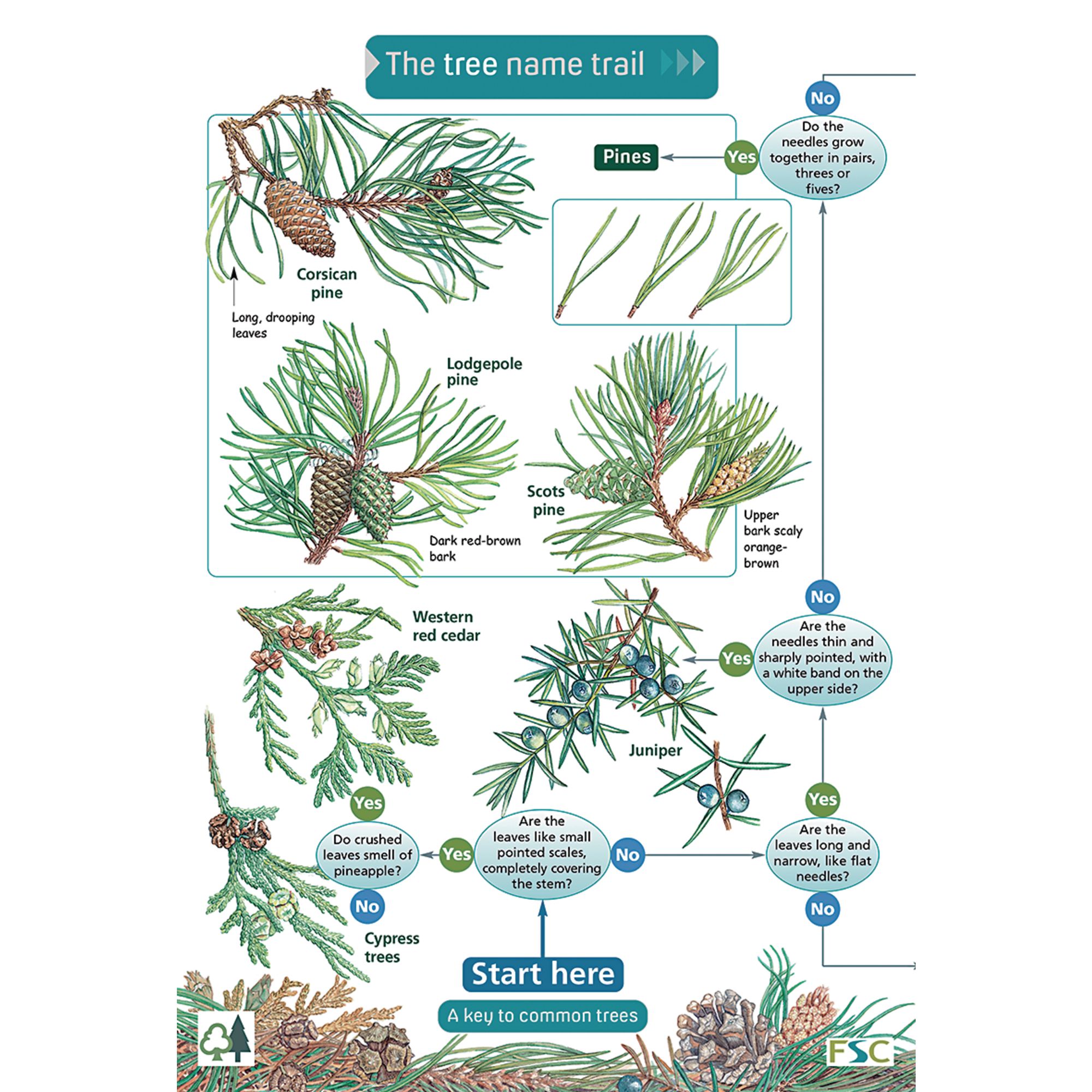
Field Studies Council Name Trail - Trees
Name Trails guide users through a simple key to help them to identify the plants and animals that they find. Text on the reverse side of the charts provides further information. Splash proof and wipe clean for outdoor use. They are small enough to take into the field as the charts fold to B5 size (approximate size: 240 x 180mm).
The Field Studies Council Tree name trail features 34 of the commonest broadleaved and conifer trees found in Great Britain and Ireland.
Use the guide's straightforward flow chart for speedy tree identification. Want to tell apart beech and hornbeam? Maple and sycamore? Ash and rowan? Simple yes/no questions will quickly guide you to the colour illustrations for each tree.
Text on the reverse side covers the features of each tree, including leaf shape, flowers, bark, fruits and seeds, habitat, origin and commercial use. Having decided your specimen is a tree, the coloured flow chart will provide you with a name. You can then check your identification using the tree identification guide.
You do not need to be an expert to use our tree guide. Even if you are a beginner you should be able to put a name to the common trees found in your area. But please don't just stop at finding the name. The guide shows you how trees of different types can be useful to us. Since most people now live in or near large towns and cities means that we may be unaware of the importance of trees and woodlands. So by discovering the names of nearby trees, all sorts of interesting facts can be uncovered, hopefully leading to action to protect and conserve our woodlands in the future.
The Field Study Council Tree name trail was produced in partnership with the Forestry Commission.
Description
Name Trails guide users through a simple key to help them to identify the plants and animals that they find. Text on the reverse side of the charts provides further information. Splash proof and wipe clean for outdoor use. They are small enough to take into the field as the charts fold to B5 size (approximate size: 240 x 180mm).
The Field Studies Council Tree name trail features 34 of the commonest broadleaved and conifer trees found in Great Britain and Ireland.
Use the guide's straightforward flow chart for speedy tree identification. Want to tell apart beech and hornbeam? Maple and sycamore? Ash and rowan? Simple yes/no questions will quickly guide you to the colour illustrations for each tree.
Text on the reverse side covers the features of each tree, including leaf shape, flowers, bark, fruits and seeds, habitat, origin and commercial use. Having decided your specimen is a tree, the coloured flow chart will provide you with a name. You can then check your identification using the tree identification guide.
You do not need to be an expert to use our tree guide. Even if you are a beginner you should be able to put a name to the common trees found in your area. But please don't just stop at finding the name. The guide shows you how trees of different types can be useful to us. Since most people now live in or near large towns and cities means that we may be unaware of the importance of trees and woodlands. So by discovering the names of nearby trees, all sorts of interesting facts can be uncovered, hopefully leading to action to protect and conserve our woodlands in the future.
The Field Study Council Tree name trail was produced in partnership with the Forestry Commission.
Specifications
GB
60103926
0.8kg
170mm
3mm
250mm
Name Trail
Environmental Science
Field Studies